Best Email Warm-Up Tools in 2026: What Works, What Does Not
Truitt Dill · · Updated
The email warm-up tool market has exploded in the last two years. Every cold email platform either has its own built-in warming feature or recommends a third-party tool. The marketing language around these products is compelling: automate your warm-up, build your reputation on autopilot, never worry about inbox placement again. The reality is significantly more nuanced.
This guide explains how automated email warm-up tools actually work, what they can genuinely help with, where they fall short, and what questions you should be asking before investing in one.
How Email Warm-Up Tools Work
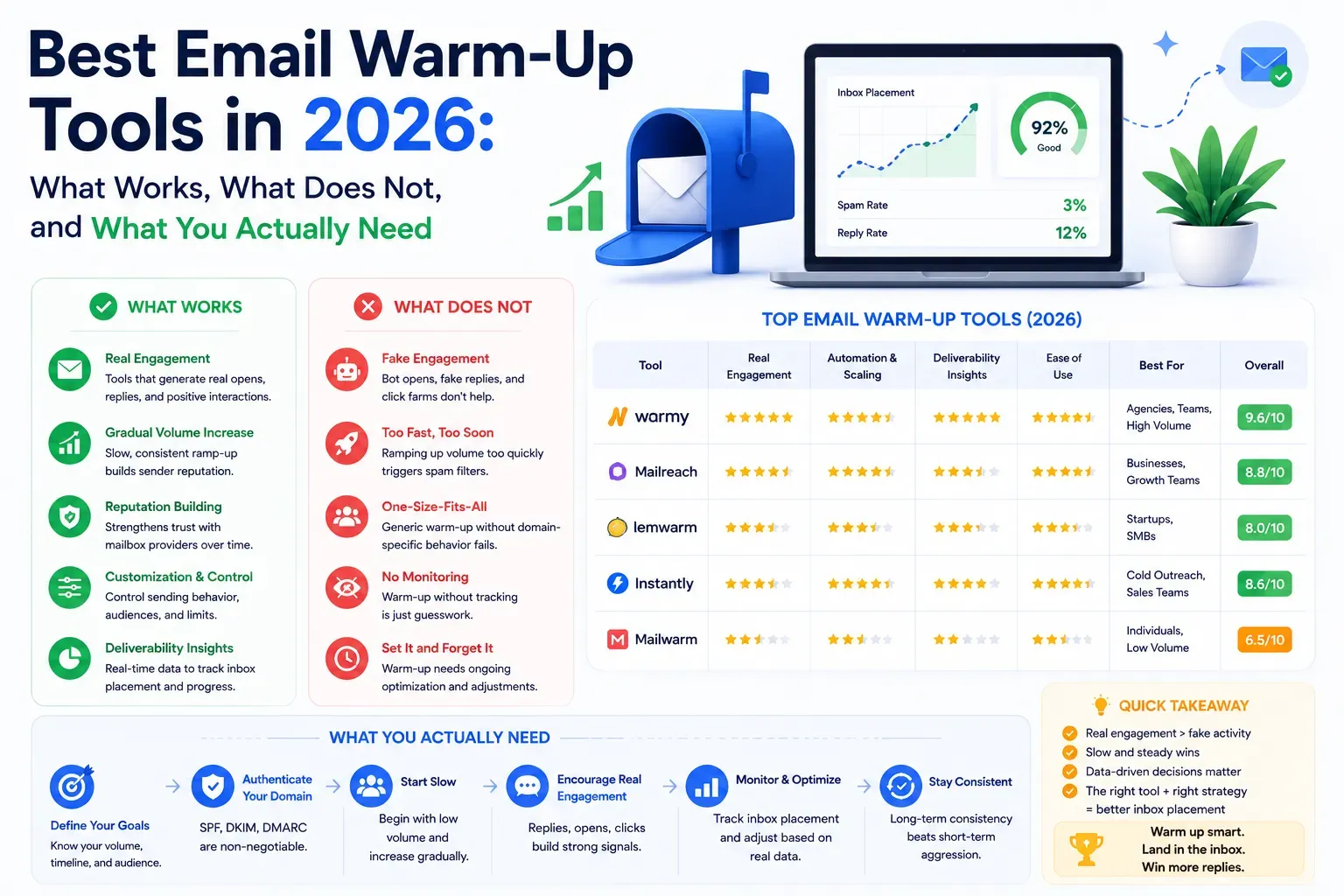
Automated warm-up tools work by connecting to your email account and automatically sending small volumes of emails to a network of other accounts also enrolled in the warm-up service. These emails simulate real human sending behavior — they include short text content, receive replies, get moved from spam to inbox, and generate engagement signals. The theory is that this simulated engagement builds your domain and IP reputation with inbox providers before you start sending your real emails.
Most tools in this category — Lemwarm, Warmup Inbox, Mailreach, Instantly's warming feature, and others — operate on this shared seed network model. You connect your email account, the tool starts automatically sending and responding to emails from other accounts in the network, and it reports back on your placement rates within that network over time.
Validity's Heatwave Blocklist Changes the Risk
On September 3, 2026, Validity launched Heatwave, a blocklist of sending domains it sees taking part in automated warm-up pools like the ones described above. Validity says the list is used or evaluated by mailbox and security providers including Comcast, Proofpoint, Spamhaus and SURBL.
Heatwave lists the domain, not the IP address, so changing IPs or sending platforms does not get you off it. According to Validity's listing policy, these listings do not expire when you stop using the warm-up tool or stop cold outreach. A domain comes off the list only if Validity reviews it and finds the listing was a mistake. Validity can also add other domains from the same operator as an advisory listing before they send anything.
In practice, a domain you enroll in a warm-up pool today can carry that record indefinitely. Our full breakdown of the Heatwave blocklist covers how to check your domains and what to do if one is listed.
What Warm-Up Tools Genuinely Help With
For new domains that are about to begin cold email outreach, automated warm-up tools generate consistent low-volume sending activity that establishes a minimal sending history for the domain. Before Heatwave, that made them a reasonable shortcut compared with sending nothing at all before a cold outreach campaign, which is the most damaging approach. Now a pool-based tool puts the domain itself at risk of a listing that does not go away. A manual warm-up builds the same sending history without that risk.
They also provide some placement reporting data within the warm-up network, which at minimum tells you whether your email is successfully reaching those specific seed accounts. It does not tell you where your mail lands for real recipients.
Our email warming best practices guide covers the principles of proper domain warming — including what warm-up tools can and cannot replace.
The Significant Limitations of Automated Warm-Up Tools
The core limitation of warm-up tool networks is that the engagement they generate is not real. Inbox providers like Gmail and Yahoo are sophisticated systems that analyze engagement signals in context. Automated emails being automatically replied to by other seed accounts in a closed network do not generate the same reputation signals as real human recipients choosing to open, read, and respond to your emails. Gmail in particular is known to have become increasingly sophisticated at distinguishing organic engagement from simulated warming activity.
Warm-up tools also cannot fix a fundamental domain reputation problem. If your domain was previously used for spam, was listed on blacklists, or has a documented history of high complaint rates in Google Postmaster Tools, running it through a warm-up tool for 30 days will not meaningfully change your reputation with Gmail or Outlook. Reputation recovery requires sending real emails to real engaged subscribers — not simulated activity to a closed network.
The most dangerous misconception about warm-up tools is that they provide protection that allows you to ignore other deliverability fundamentals. No warm-up tool can compensate for broken SPF, DKIM, or DMARC authentication. No warm-up tool can protect you from blacklisting caused by spam complaints from your actual recipients. These tools are a supplement to good deliverability practices, not a replacement for them.
What You Actually Need Instead of a Warm-Up Tool
For cold email senders: the most effective warm-up is a proper manual warm-up protocol. Start with your most engaged contacts — people who know you and are likely to open your email — at low volumes (50 to 100 per day), and scale gradually over four to six weeks before beginning cold outreach at scale. This generates real engagement signals that actually move your domain reputation in the right direction.
Proper authentication (SPF, DKIM, DMARC) configured correctly from day one is more important for long-term deliverability than any warm-up tool. Our email infrastructure services include setting up authentication and designing a warm-up plan for new domains and new IP addresses. See infrastructure and warm-up plan pricing.
Regular inbox placement testing using real seed accounts across Gmail, Outlook, Yahoo, and Apple Mail gives you actual data about where your emails are landing — which is more useful than the placement data generated within a closed warm-up network. Formula Inbox offers a complimentary inbox placement test to give you a real baseline reading.
If You Already Use a Warm-Up Tool
If a domain you care about is enrolled in a pool-based warm-up tool, turn off the automated warm-up now. Stopping will not remove a Heatwave listing that already exists, but it is the step Validity itself recommends.
Check the domain on Validity's Heatwave lookup. If it is listed and you believe the listing is wrong, you can request a review, which Validity says typically takes 2 to 5 business days. If the listing is accurate, plan to move important sending to a domain that has never been in a warm-up pool, and warm it manually with real recipients.
Keep monitoring your actual deliverability through Google Postmaster Tools. Do not rely on a warm-up tool's internal placement metrics, and do not skip proper authentication and list hygiene.
A pool-based warm-up tool is now a liability, not a convenience. Real domain reputation is built through real engagement from real people who find real value in your emails. No tool automates that.
If you are starting a new email program or migrating to new infrastructure and want to build your reputation correctly from day one, Formula Inbox's email infrastructure services include a structured warm-up plan tailored to your specific situation. Talk to our team before you invest in a warm-up tool to make sure you are solving the right problem.