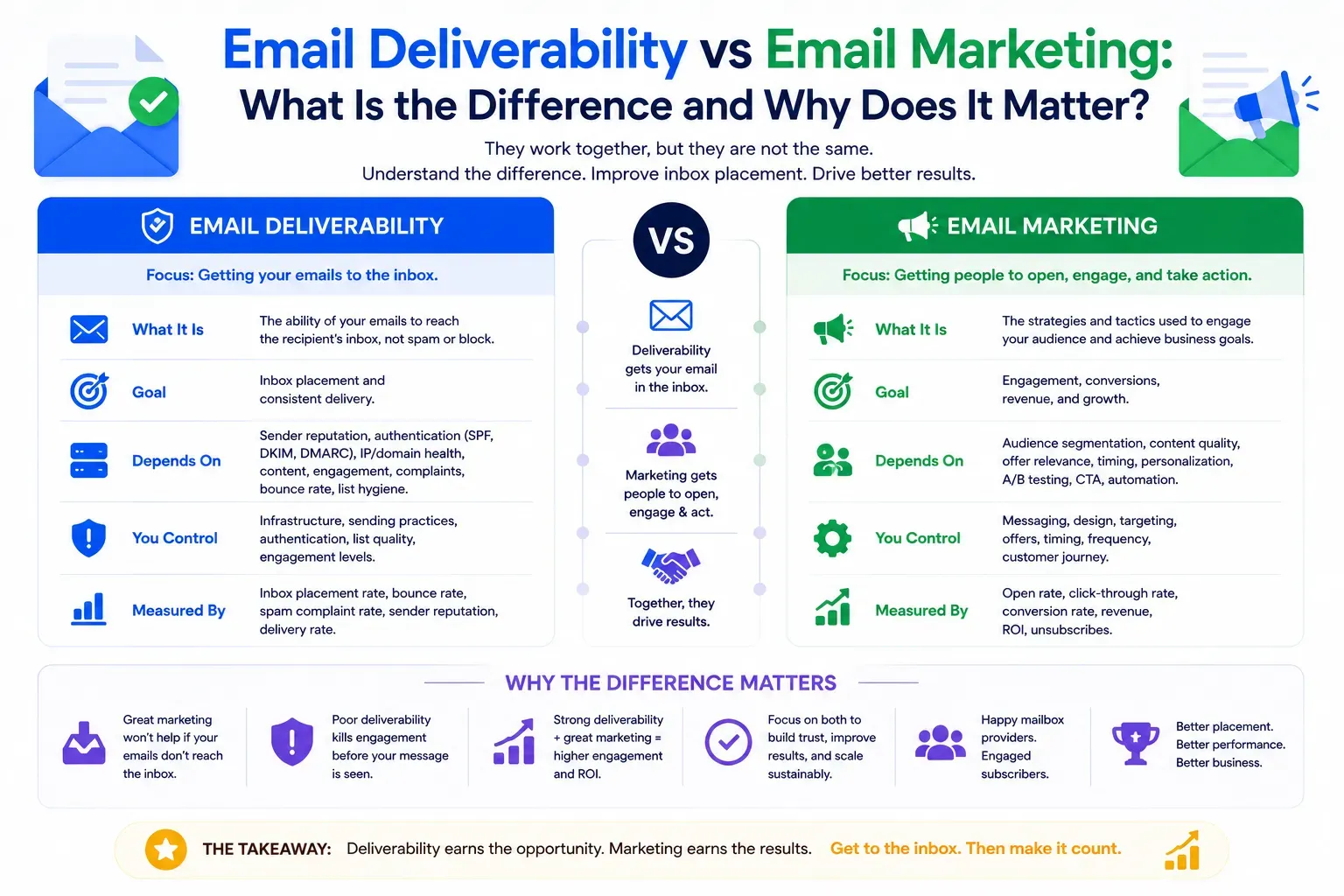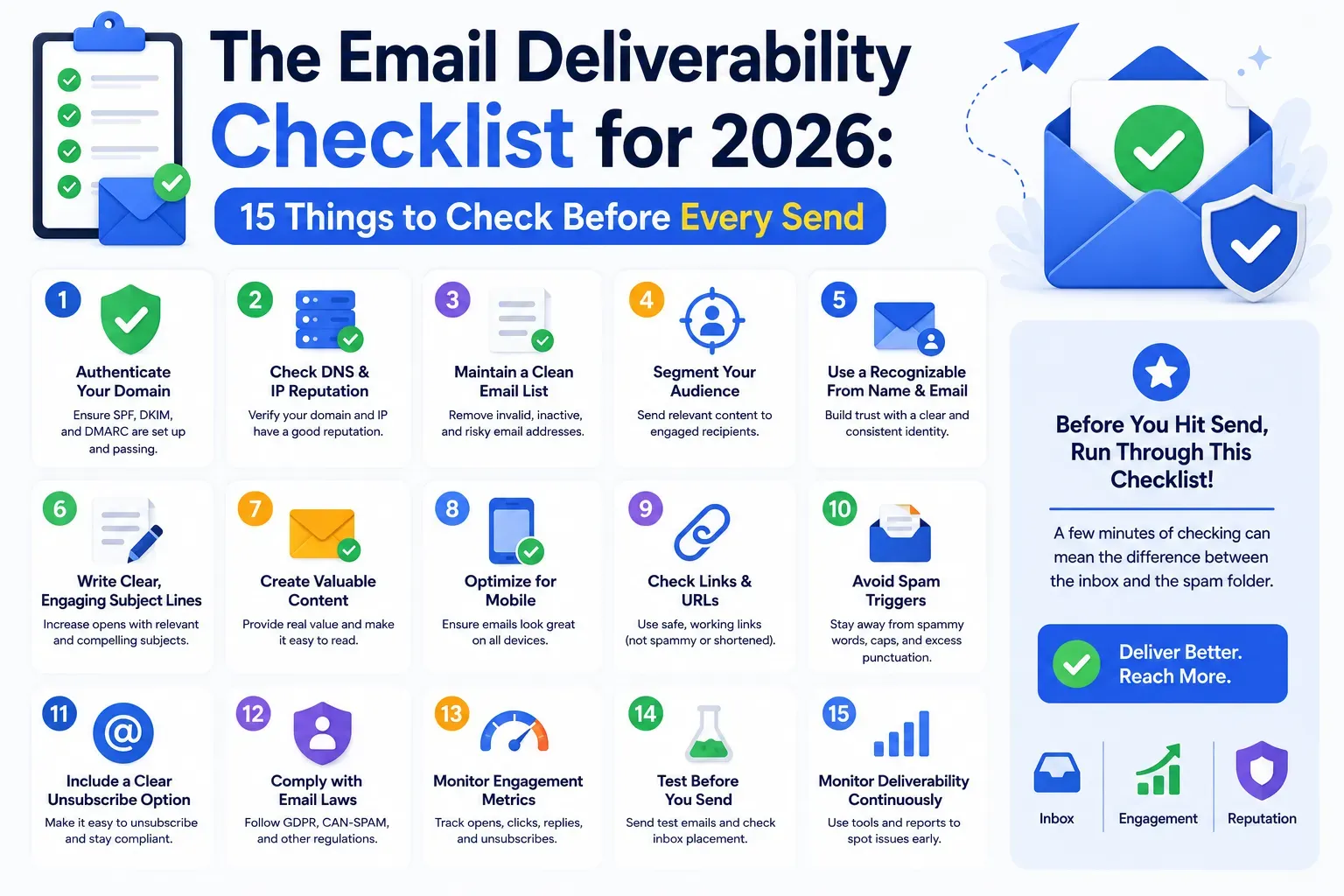
Email deliverability is the measure of how likely your emails are to reach your recipients' primary inboxes rather than their spam folders, promotions tabs, or nowhere at all. It sounds straightforward but in practice it is one of the most technically complex and misunderstood areas of digital marketing.
A lot of people confuse email delivery with email deliverability and the difference matters enormously. If you treat them as the same thing you will make decisions based on incomplete data and consistently miss the actual problems affecting your campaigns.
Email Delivery vs Email Deliverability: The Critical Difference
Email delivery means the email was accepted by the receiving mail server and did not hard bounce. It tells you the address exists and the server accepted the message. That is all it tells you.
Email deliverability goes further. It tells you where inside the receiving server that email ended up. Did it reach the primary inbox? The spam folder? The promotions tab? Or was it quietly filtered without any notification back to you?
Most email platforms report delivery rates, not deliverability rates, which is why senders often believe their campaigns are performing well when a significant portion of their emails are being silently filtered. Research consistently shows that between 14 and 17 percent of legitimate marketing emails never reach the inbox, even when they are technically delivered.
A Very Common Misconception
Your email platform showing a 99 percent delivery rate does not mean 99 percent of your emails reached the inbox. It means 99 percent were accepted by the receiving server. What happened after that is deliverability.
How Email Deliverability Works: The Journey of Every Email You Send
Step 1: Connection and Authentication Checks
The receiving mail server first checks whether your sending server is who it claims to be. It looks up your SPF record to see if your server is on the authorised list. It checks your DKIM signature to verify the message has not been tampered with. It reads your DMARC record to understand what to do if those checks fail.
Step 2: Sender Reputation Check
If authentication passes, the server looks up the reputation of your sending domain and IP address. If your domain has a history of generating spam complaints, if it appears on blacklists, or if its sending patterns look suspicious, the filter will act on that information before the email ever reaches an inbox.
Step 3: Content Analysis
Spam filters analyse the content of your email including the subject line, the body text, the links it contains, the ratio of images to text, and even the structure of your HTML. Certain patterns trigger filters even in otherwise well-maintained email programs.
Step 4: Inbox Provider Decision
Based on all of the above, the inbox provider makes a decision in milliseconds. Primary inbox, promotions tab, spam folder, or rejected outright. This decision is invisible to you unless you are actively testing or monitoring your deliverability.
The Key Factors That Affect Email Deliverability
Marketing, Sales and Transactional Email: How Deliverability Differs
Not every email you send plays by the same rules. Marketing, sales and transactional email each have a different purpose, a different audience expectation and different deliverability requirements. Treat them the same and you risk damaging your sender reputation and pushing all of them toward spam.
Marketing Email
Newsletters, promotional offers, event invites and product announcements. Marketing email is sent in bulk to large segments of your list, and its job is to inform, promote or nurture rather than close a deal on the spot.
It depends on consent and on engagement. If recipients stop opening and clicking, inbox providers may stop placing it in the inbox. Use only permission-based lists and never buy them, segment so each email reaches people who want it, and control your sending frequency, because too many sends drive up complaints.
Sales Email
One-to-one or small-batch outreach from a rep to a prospect: cold or semi-warm outreach and follow-ups, usually personalised to the recipient. It should read like a conversation, not a mass send.
Warm up your domain before you scale outreach. Keep messages short and personal. Limit daily volume, because sudden spikes in cold email are a fast route to the spam folder. Send cold outreach from a separate domain and sending infrastructure, or problems there can damage the deliverability of all your email.
Transactional Email
Order confirmations, password resets, receipts and shipping updates. These are triggered by a user action, recipients expect them, and recipients cannot opt out of them the way they opt out of marketing email. They are essential to customer experience, so they need to arrive reliably.
Send them from a clearly branded address such as orders@yourbrand.com and keep the content focused on the transaction. A small upsell is fine, but too much promotional content makes a transactional email look like marketing.
Because each type has different requirements, each needs its own sending infrastructure and configuration. If you need help setting that up, see our email infrastructure service.
How to Measure Your Email Deliverability
Inbox Placement Rate
This is the most direct measure of deliverability. It tells you what percentage of your emails are landing in the inbox versus the spam folder. You need a seed list or an inbox placement testing tool to measure this. Formula Inbox offers a complimentary inbox placement test that gives you this data across major providers at no cost.
Google Postmaster Tools
If you send to Gmail addresses, Google Postmaster Tools gives you direct insight into your spam complaint rate, compliance with Gmail's sender requirements, authentication results, and delivery errors as seen by Gmail. It is free and provides data that no third-party tool can replicate.
Key Email Deliverability Metrics to Track
Understanding which metrics to watch and what benchmarks to target is essential. Read our guide on the most important email deliverability metrics to know exactly what to measure and what the numbers mean. To see how these checks fit together, read what a deliverability audit checks.
What Good Email Deliverability Looks Like
A healthy email program typically shows inbox placement rates above 90 percent, spam complaint rates below 0.1 percent, bounce rates below 2 percent, and every compliance check passing in Google Postmaster Tools. Formula Inbox consistently delivers 90 percent or higher inbox placement rates for clients across industries.
Getting Professional Help With Email Deliverability
Some deliverability problems are straightforward to fix. Others are more complex and require professional diagnosis. If you are experiencing persistent problems despite following best practices, Formula Inbox offers a professional email deliverability audit that covers your full sending environment and provides a prioritised plan to resolve any issues found. You can also talk to one of our deliverability experts at no charge before deciding on next steps. If you are deciding whether to bring in outside help, see what an email deliverability consultant does.