
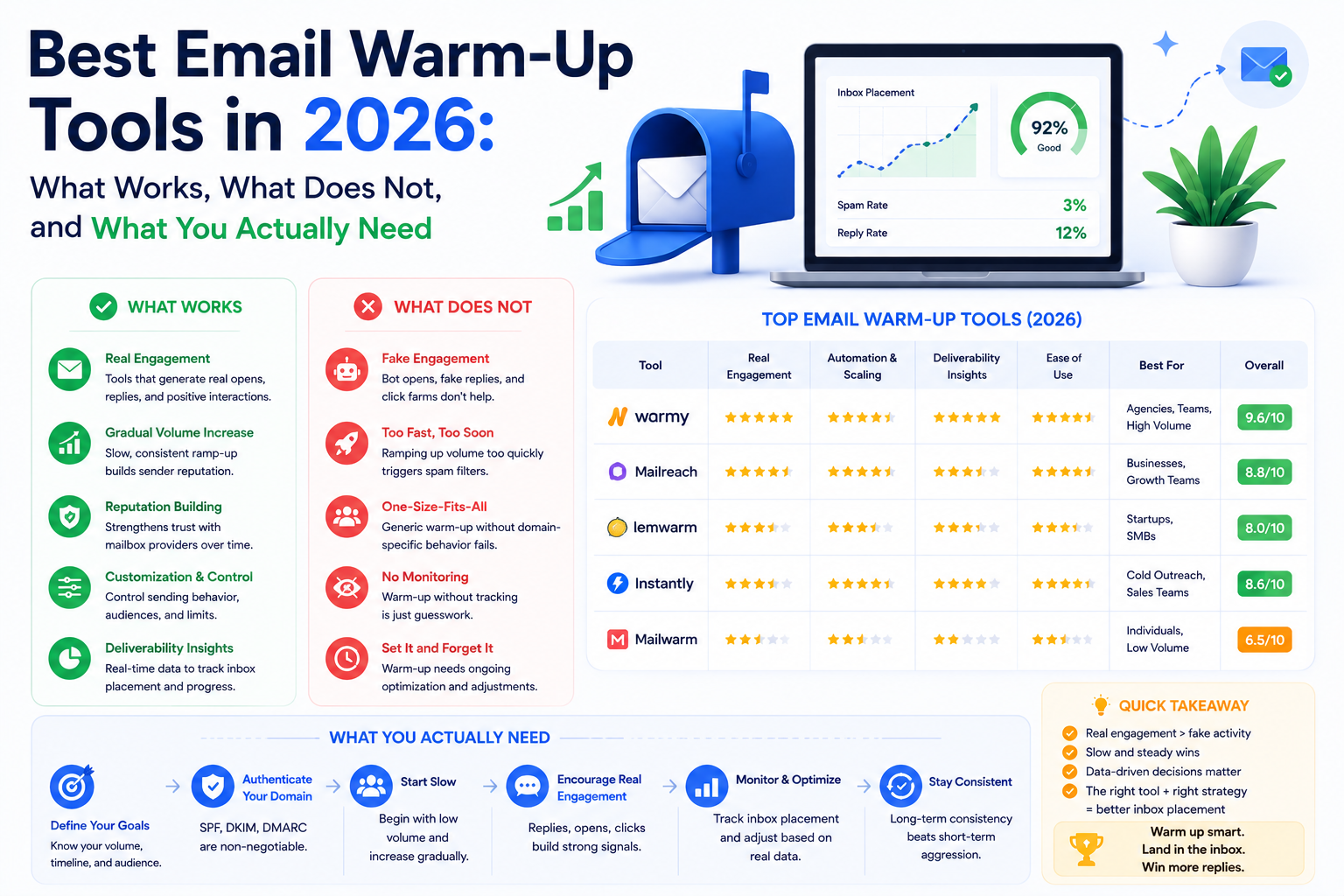
The email warm-up tool market has exploded in the last two years. Every cold email platform either has its own built-in warming feature or recommends a third-party tool. The marketing language around these products is compelling: automate your warm-up, build your reputation on autopilot, never worry about inbox placement again. The reality is significantly more nuanced.
This guide explains how automated email warm-up tools actually work, what they can genuinely help with, where they fall short, and what questions you should be asking before investing in one.
Automated warm-up tools work by connecting to your email account and automatically sending small volumes of emails to a network of other accounts also enrolled in the warm-up service. These emails simulate real human sending behavior — they include short text content, receive replies, get moved from spam to inbox, and generate engagement signals. The theory is that this simulated engagement builds your domain and IP reputation with inbox providers before you start sending your real emails.
Most tools in this category — Lemwarm, Warmup Inbox, Mailreach, Instantly's warming feature, and others — operate on this shared seed network model. You connect your email account, the tool starts automatically sending and responding to emails from other accounts in the network, and it reports back on your placement rates within that network over time.
For new domains that are about to begin cold email outreach, automated warm-up tools serve a legitimate purpose: they generate consistent low-volume sending activity that establishes a minimal sending history for the domain. This is better than sending no emails at all before launching a cold outreach campaign, which is the most damaging approach.
They also provide some placement reporting data within the warm-up network, which at minimum tells you whether your email is successfully reaching those specific seed accounts. For early-stage cold email programs on a budget, this is useful baseline information.
Our email warming best practices guide covers the principles of proper domain warming — including what warm-up tools can and cannot replace.
The core limitation of warm-up tool networks is that the engagement they generate is not real. Inbox providers like Gmail and Yahoo are sophisticated systems that analyze engagement signals in context. Automated emails being automatically replied to by other seed accounts in a closed network do not generate the same reputation signals as real human recipients choosing to open, read, and respond to your emails. Gmail in particular is known to have become increasingly sophisticated at distinguishing organic engagement from simulated warming activity.
Warm-up tools also cannot fix a fundamental domain reputation problem. If your domain was previously used for spam, was listed on blacklists, or has a documented history of high complaint rates in Google Postmaster Tools, running it through a warm-up tool for 30 days will not meaningfully change your reputation with Gmail or Outlook. Reputation recovery requires sending real emails to real engaged subscribers — not simulated activity to a closed network.
The most dangerous misconception about warm-up tools is that they provide protection that allows you to ignore other deliverability fundamentals. No warm-up tool can compensate for broken SPF, DKIM, or DMARC authentication. No warm-up tool can protect you from blacklisting caused by spam complaints from your actual recipients. These tools are a supplement to good deliverability practices, not a replacement for them.
For cold email senders: the most effective warm-up is a proper manual warm-up protocol. Start with your most engaged contacts — people who know you and are likely to open your email — at low volumes (50 to 100 per day), and scale gradually over four to six weeks before beginning cold outreach at scale. This generates real engagement signals that actually move your domain reputation in the right direction.
Proper authentication (SPF, DKIM, DMARC) configured correctly from day one is more important for long-term deliverability than any warm-up tool. Our email infrastructure services include setting up authentication and designing a warm-up plan for new domains and new IP addresses.
Regular inbox placement testing using real seed accounts across Gmail, Outlook, Yahoo, and Apple Mail gives you actual data about where your emails are landing — which is more useful than the placement data generated within a closed warm-up network. Formula Inbox offers a complimentary inbox placement test to give you a real baseline reading.
If you decide a warm-up tool is appropriate for your situation, use it alongside proper manual warm-up — not instead of it. Keep the automated warm-up volume low enough that it represents a small fraction of your total sending activity. Do not rely on the tool's internal placement metrics as your primary measure of deliverability health. And absolutely do not skip proper authentication and list hygiene because you think the warm-up tool is handling your deliverability.
Monitor your actual deliverability through Google Postmaster Tools throughout the warm-up period. If your domain reputation is not improving in Postmaster Tools over the course of four to six weeks of warming, the warm-up tool is not solving your underlying problem — and continuing with it while ignoring that signal is a mistake.
A warm-up tool is a convenience, not a solution. Real domain reputation is built through real engagement from real people who find real value in your emails. No tool automates that.
If you are starting a new email program or migrating to new infrastructure and want to build your reputation correctly from day one, Formula Inbox's email infrastructure services include a structured warm-up plan tailored to your specific situation. Talk to our team before you invest in a warm-up tool to make sure you are solving the right problem.

Microsoft's 2025–2026 changes to Exchange Online — TERRL, MERRL, and AI-assisted filtering — are breaking cold email infrastructure that worked two years ago.

Master SDR email deliverability. Learn how to avoid spam filters, optimize sending cadence, and boost reply rates with this expert sales outreach guide.
.webp)
Tired of your emails landing in spam? Learn how to improve email deliverability with our guide on list hygiene, authentication (SPF/DKIM), reputation, and more.
Our highly experienced email deliverability managers consistently help clients achieve inbox placement rates (IPR) of more than 90% by uncovering and resolving the issues that keep messages from their intended recipients. Are you ready to do the same?