
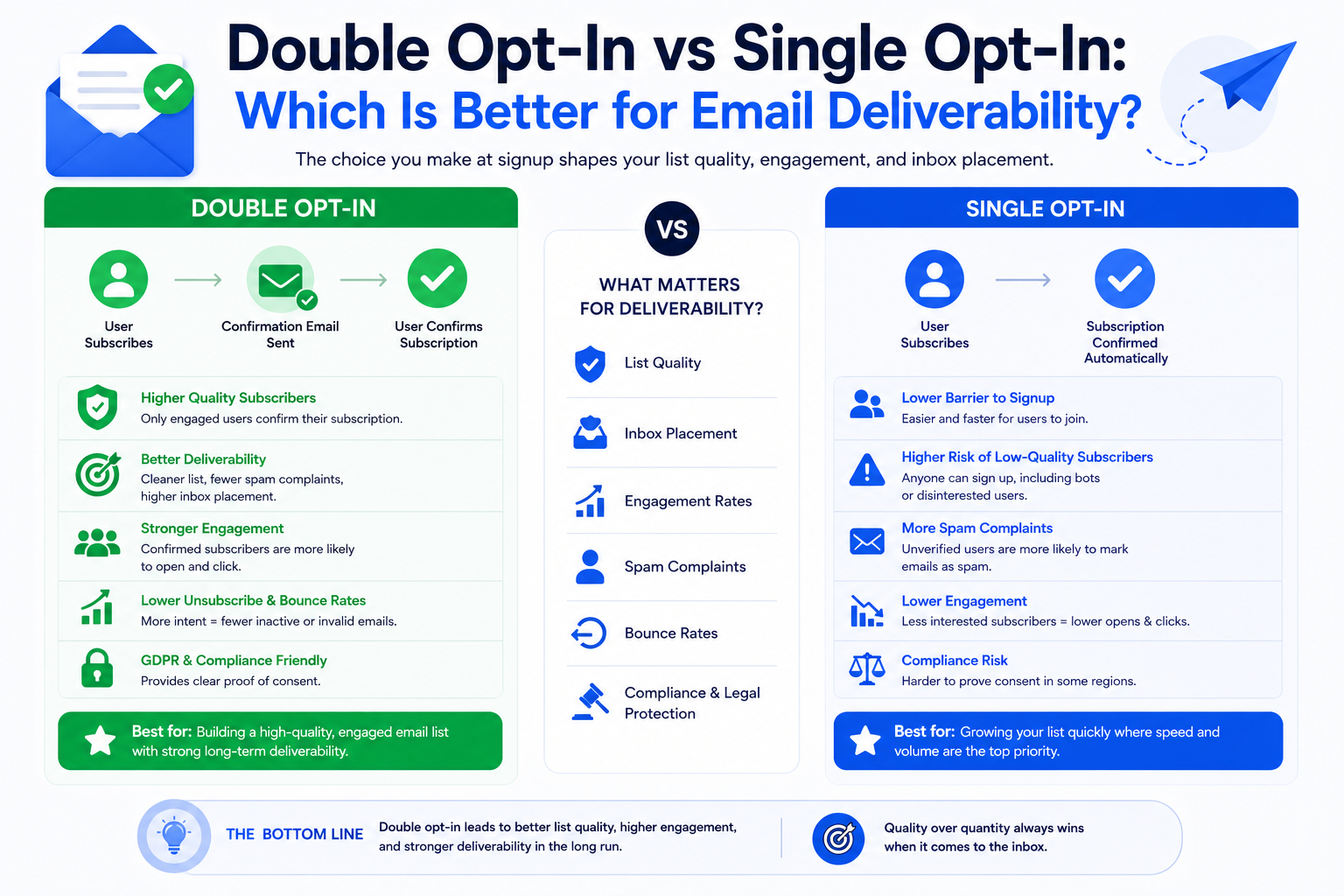
The debate between double opt-in and single opt-in has been running for years, and it generates strong opinions on both sides. Marketers who prioritize list growth argue that double opt-in creates unnecessary friction and reduces subscriber acquisition. Deliverability and compliance professionals argue that double opt-in is essential for list quality and inbox placement. As with most things in email marketing, the truth is more nuanced than either extreme.
This guide explains exactly what double opt-in does to your deliverability, where the real trade-offs lie, and how to make the right decision for your specific program.
With single opt-in, a subscriber enters their email address in a form and immediately gets added to your list. They start receiving emails right away, with no further action required. This is the fastest path to adding subscribers and the most common approach across email marketing.
With double opt-in (also called confirmed opt-in), after someone submits their email address, they receive a confirmation email with a link they must click to verify their address and complete the subscription. Only subscribers who click the confirmation link are added to your active list. Someone who signs up but never clicks the confirmation email does not receive further emails.
The deliverability benefits of double opt-in come from what it prevents, not just what it enables.
It eliminates invalid email addresses immediately. When someone enters a typo — a common mistake that affects 2 to 5% of form submissions — the confirmation email bounces or goes undelivered. The subscriber never confirms and never enters your list. This directly reduces your hard bounce rate without any list cleaning effort on your part.
It filters out disengaged subscribers before they become a problem. Someone who cannot be bothered to click a confirmation link is almost certainly not going to open your regular emails either. Excluding them at entry keeps your engagement rates naturally higher, which is a direct positive signal to spam filters that assess your emails based on recipient behavior.
It provides explicit proof of consent. In the event that a subscriber disputes receiving your emails or a regulatory body questions your list acquisition practices, a confirmed opt-in provides a timestamped record of the subscriber actively choosing to receive your emails. This matters increasingly as GDPR enforcement becomes more active and similar regulations spread globally.
It virtually eliminates spam trap risk from your acquisition channel. Spam traps — email addresses set up to catch senders with poor list acquisition practices — cannot trigger a confirmation link click. A sender using double opt-in will rarely encounter a spam trap from their organic signup process.
The main cost is reduced list growth rate. Industry data consistently shows that double opt-in confirmation steps reduce subscriber acquisition by 15 to 30% compared to single opt-in, depending on how the confirmation email is written and how motivated the audience is. Some prospects sign up impulsively and never confirm. Others are genuinely interested but forget. For businesses where email list growth is a primary metric, this reduction in acquisition rate is a real cost.
The question is whether the subscribers you are losing in the confirmation step are actually valuable. If 20% of your signups do not confirm, you are losing 20% of your potential list — but you are also losing the 20% who were least motivated to receive your emails. The engaged 80% who did confirm will almost always outperform the full unfiltered 100% on every meaningful metric: open rates, click rates, purchase rates, and deliverability signals.
Double opt-in is clearly the right choice for any business where list quality matters more than list size — which in practice means any business where deliverability and engagement quality are revenue drivers. Ecommerce brands who depend on high engagement rates to reach the inbox. SaaS companies where email drives product adoption and retention. B2B marketers who track revenue attribution back to specific subscribers. Any sender who has experienced deliverability problems caused by list quality issues.
It is also the right choice for any sender with significant European subscribers, where GDPR requires a clear and documented basis for email marketing consent, and where confirmed opt-in provides the strongest available documentation of that consent.
Single opt-in is appropriate when you are collecting email addresses in contexts where intent is already very high — for example, a checkout page where a customer is making a purchase and checking a clearly labeled opt-in box. In this context, the subscriber has demonstrated strong purchase intent, their email address is almost certainly valid (they just provided it for a transaction), and the risk of spam complaints is low because they have an existing relationship with your brand.
Single opt-in is also workable when your list is small, your engagement rates are naturally high, and you have robust list cleaning processes that catch and remove invalid addresses quickly. The deliverability risks of single opt-in can be managed — they just require more active list hygiene than double opt-in.
If you choose double opt-in, the confirmation email itself is critical. A poorly written or delayed confirmation email will reduce your confirmation rate significantly, making the perceived cost of double opt-in higher than it needs to be.
Send the confirmation email immediately — within seconds of form submission. A delay of even a few hours dramatically reduces confirmation rates. Write the subject line to be direct and expected: something like "Please confirm your subscription to [Brand Name]" or "One more step to complete your signup." Keep the email very short and focused entirely on getting the click. Put the confirmation button prominently above the fold with a clear label. Explain briefly what they signed up for to remind them why they were interested.
A list of 10,000 confirmed, engaged subscribers will outperform a list of 15,000 unfiltered subscribers on every deliverability metric that matters — and generate better revenue outcomes at the same time.
If your list acquisition practices are contributing to deliverability problems — whether through high bounce rates from invalid addresses, spam trap hits, or low engagement — a Formula Inbox email deliverability audit will identify the specific issues and give you a clear remediation plan. Talk to our team to discuss your current list acquisition setup.

Got blacklisted? Our email blacklist remediation guide walks you through identifying which blocklist you're on, why it happened, and the exact steps.

What are the metrics for email deliverability? Discover the KPIs that matter most , open rates, bounce rates, spam complaints, sender score & more.

Discover how GDPR, CAN-SPAM, and CASL laws affect email deliverability. Learn best practices to stay compliant, protect your business, and build customer trust.
Our highly experienced email deliverability managers consistently help clients achieve inbox placement rates (IPR) of more than 90% by uncovering and resolving the issues that keep messages from their intended recipients. Are you ready to do the same?