
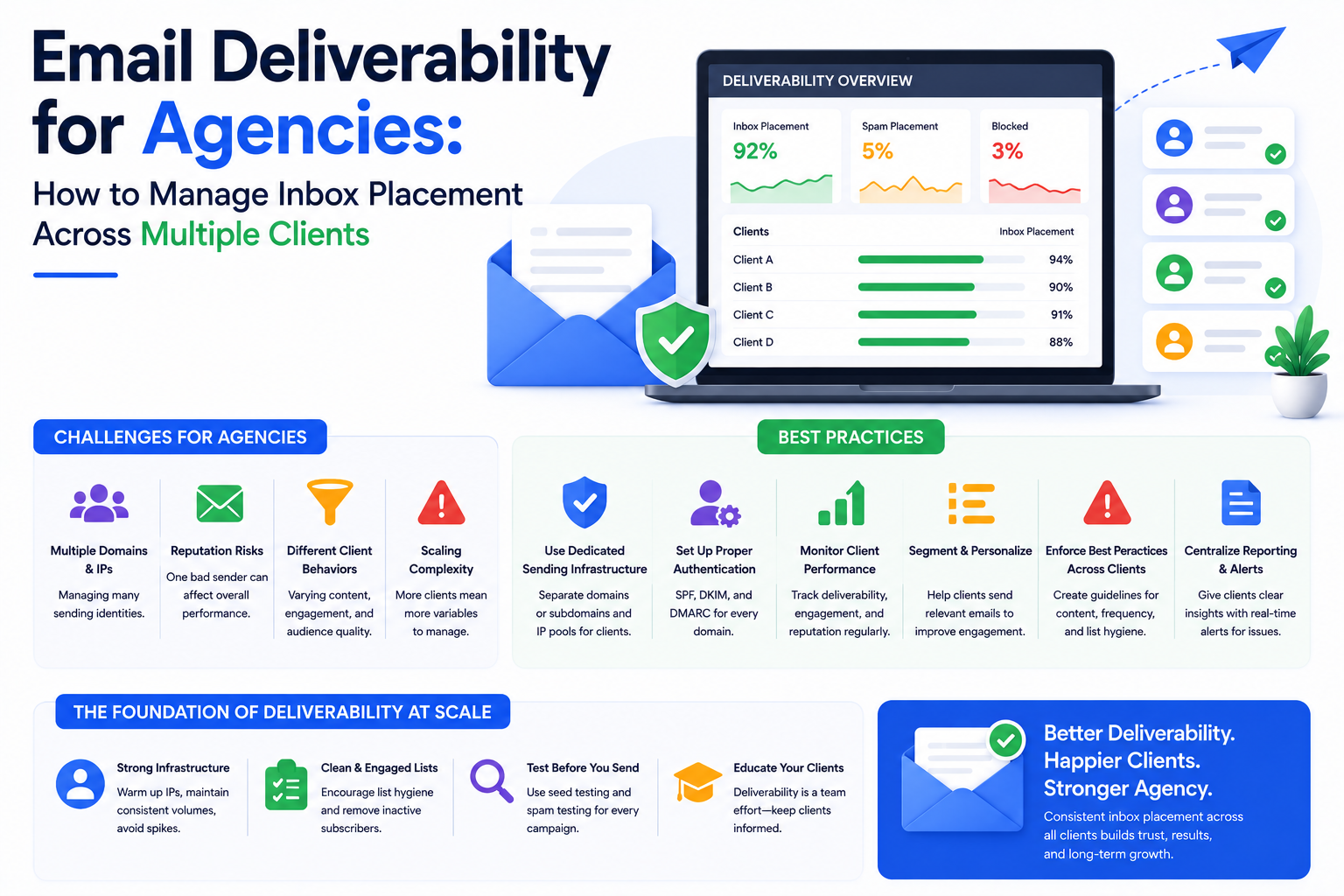
Running email marketing for a single brand is complex enough. Running it for 10 or 20 clients simultaneously — each with different lists, different sending behaviors, different platforms, and different levels of prior deliverability hygiene — introduces a layer of infrastructure and risk management that most agencies underestimate until something goes seriously wrong.
When deliverability breaks down at an agency, it often does not just affect one client. Shared infrastructure, commingled sending domains, or agency-level IP pools can create cascading reputation failures where one client's bad practices damage the inbox placement of others. This guide explains how to structure your agency's email infrastructure to prevent this and how to proactively manage deliverability across an entire client portfolio.
The single most important principle in agency email deliverability is that each client must have completely isolated sending infrastructure. This means a unique sending domain (or subdomain) per client, with its own SPF, DKIM, and DMARC authentication configured specifically for that domain. It means dedicated IP addresses for clients who send at sufficient volume rather than sharing agency-level IP pools. And it means that the reputation signals generated by each client's sending behavior attach only to that client's infrastructure — not to yours or any other client's.
Without this isolation, a single client with a poor list, a high complaint rate, or a sudden spam incident can contaminate the sending reputation of your entire agency infrastructure. You become responsible for deliverability problems you did not cause and cannot fully control. Isolation is not optional — it is the foundation of agency-level deliverability management.
Every client domain you send from needs SPF, DKIM, and DMARC records configured in their DNS. This is non-negotiable. In practice, agencies often manage DNS for multiple clients through multiple registrars and hosting providers, which adds coordination complexity but does not change the requirement.
For each client: confirm that their SPF record covers every platform used to send email on their behalf — your agency platform, their transactional provider, any other tools in the stack. Generate and install DKIM keys through every sending platform. Set up a DMARC record at a minimum of p=none with reporting directed to an email address you can monitor. Escalate DMARC policy to p=quarantine for clients who have been running clean programs for 60 or more days. Our full authentication setup guide covers the technical configuration for each record type.
List hygiene is one of the most challenging aspects of agency deliverability management because you are often dependent on clients to provide clean data. Clients bring in lists from various sources — trade show sign-ups, form submissions, CRM exports, purchased lists they promised were opt-in — and you are the one who takes the reputation hit when those lists perform poorly.
Establish a clear policy: every new list a client wants to send to must be validated before it enters any of your sending infrastructure. Use a validation service to check for invalid addresses, spam traps, and high-risk addresses before importing. Document this policy in your client contracts so the responsibility and the consequences of non-compliance are explicit.
Run re-engagement and suppression analysis for each client quarterly. Unengaged contacts accumulate invisibly in client databases and create reputation drag that is easy to miss until it shows up as declining inbox placement. Our email list management and hygiene guide covers the right approach.
Individual monitoring for each client is time-consuming at scale. The practical solution is to build monitoring infrastructure that gives you a dashboard view across all clients simultaneously rather than checking each one manually.
Set up Google Postmaster Tools for every client domain. Most agencies do this but fail to check it consistently across all accounts. Build a weekly review process where someone reviews Postmaster Tools data for every active client. Any client showing Medium or below domain reputation should trigger an immediate review of that client's recent sending activity.
Run inbox placement tests for major client campaigns before they go out. A five-minute test catches problems before they affect actual subscribers. For high-volume clients, consider ongoing seed list monitoring that continuously tests inbox placement without requiring manual pre-campaign checks.
Our ongoing deliverability support and monitoring service can be deployed at the agency level, giving you centralized visibility into reputation and placement data across your entire client portfolio.
Even with proper isolation and monitoring, clients will sometimes create deliverability crises. A client who insists on sending to a list you advised against. A sudden promotional campaign that spikes complaint rates. A spam trap hit from an old list segment that was accidentally included. When this happens, having isolation in place means the damage is contained to that client's infrastructure rather than spreading to others.
Respond immediately. Pause sending for the affected client, identify the root cause, clean the list if needed, submit delisting requests if blacklisting occurred, and execute a controlled warm-up to restore reputation. Document everything. Deliverability incidents are opportunities to demonstrate your expertise and strengthen client relationships — if you handle them transparently and competently.
For complex or serious incidents, Formula Inbox provides expert deliverability support that agencies can access for specific client situations without needing to develop full in-house expertise in every aspect of deliverability remediation.
Agencies that manage deliverability proactively, rather than reactively, have a significant competitive advantage. Deliverability monitoring, authentication management, and quarterly list hygiene reviews are services that most clients cannot do themselves and do not fully understand — which makes them high-value differentiators that justify premium retainer pricing.
Consider packaging deliverability as a named service tier: basic email management, then an advanced tier that includes monthly inbox placement reporting, quarterly list hygiene reviews, and authentication monitoring. The incremental cost to the agency is low. The perceived value to clients — especially those who have experienced deliverability problems in the past — is substantial.
In agency email management, your clients' sending behaviors affect your reputation as much as your own. Proactive isolation and monitoring are not just best practices — they are business protection.
If you are managing email deliverability across multiple clients and want a framework for auditing and protecting each account, Formula Inbox works with agencies to build and maintain the infrastructure and monitoring systems that keep every client's inbox placement strong. Start with a conversation about what your current client portfolio looks like and where the gaps are.

Explore email deliverability specialist services, including audits, IP warming, reputation management, and authentication for marketing success.

Boost your email marketing success by improving deliverability with our essential strategies and best practices for optimal results.

Learn why your sales emails hit spam and discover strategies to enhance deliverability and boost engagement for better results.
Our highly experienced email deliverability managers consistently help clients achieve inbox placement rates (IPR) of more than 90% by uncovering and resolving the issues that keep messages from their intended recipients. Are you ready to do the same?