
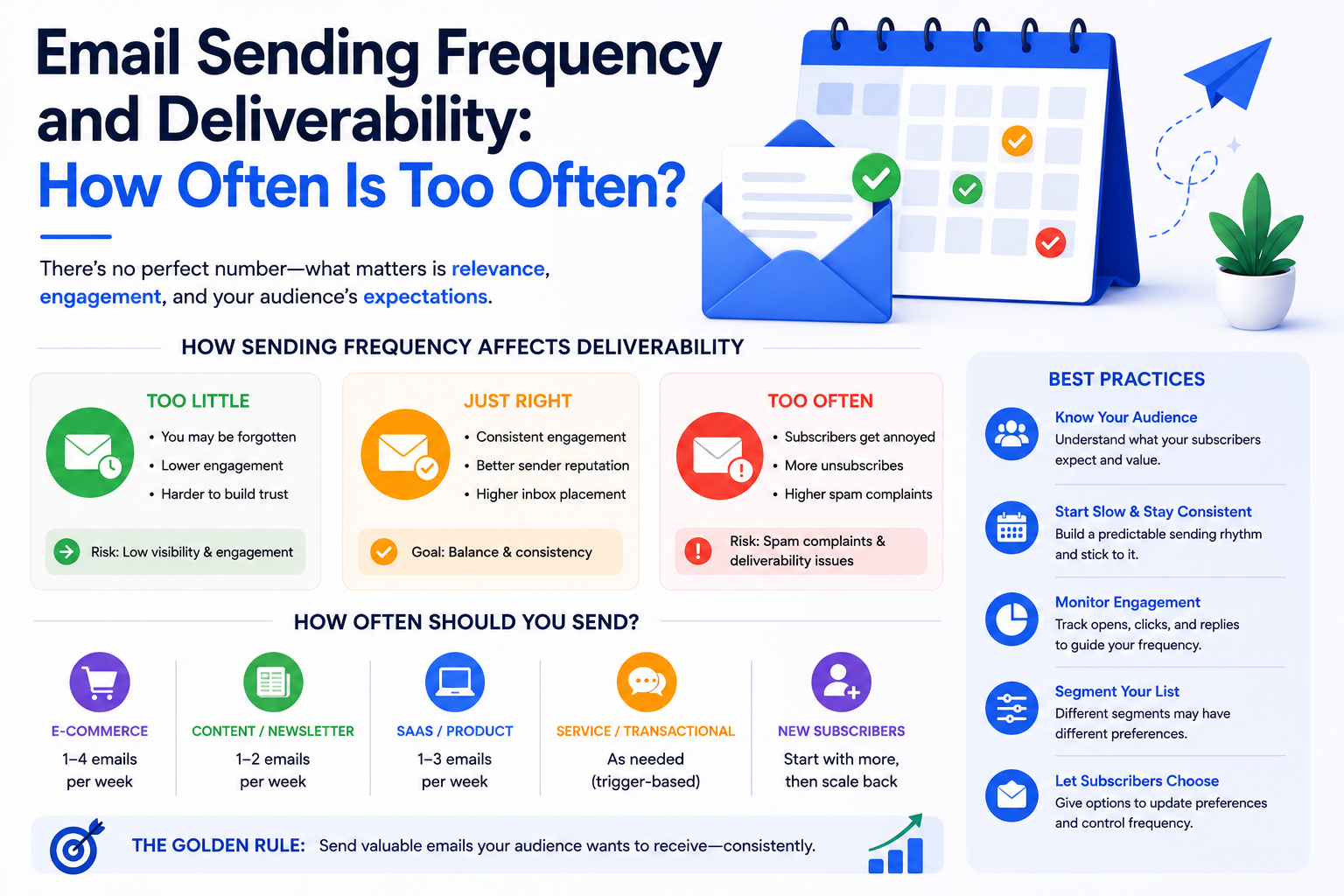
Most email marketing advice focuses on what to send and how to write it. Very little attention goes to how often to send — even though sending frequency is one of the most direct drivers of both subscriber engagement and deliverability. Send too often and you generate unsubscribes, complaints, and reputation damage. Send too rarely and your subscribers forget who you are, your engagement rates collapse, and your domain reputation degrades from inactivity.
This guide explains the relationship between sending frequency and deliverability, the signals that tell you whether your current frequency is hurting you, and how to find the cadence that keeps both your audience and your inbox providers happy.
Email deliverability is driven heavily by engagement signals. When you send more emails than your audience wants, a predictable chain of events begins. Open rates fall because people stop reading. Unsubscribe rates rise, and with them, spam complaints from subscribers who would rather hit Report Spam than find the unsubscribe link. As complaint rates climb, Gmail, Outlook, and Yahoo update their assessment of your domain reputation. And as reputation falls, future emails — even to subscribers who do want them — get filtered.
This is the compounding damage of over-sending. It does not just affect the individual email that annoyed someone. It degrades the inbox placement of every email you send afterward, including to subscribers who were perfectly happy to hear from you. Frequency decisions are reputation decisions.
Your spam complaint rate is the most important leading indicator. Gmail considers anything above 0.10% a warning. If your complaints are trending upward, reduce frequency before reducing volume — often the problem is not that you are emailing too many people, it is that you are emailing the same people too often.
A rising unsubscribe rate following a frequency increase is a clear signal that your cadence is above what your audience signed up for. If you moved from weekly to twice-weekly and your unsubscribe rate jumped, the audience is telling you directly to pull back.
Falling open rates after a frequency increase, where the absolute number of opens stays flat but the rate falls because more emails are being sent, indicate that incremental sends are producing diminishing returns. You are adding emails to your send schedule without adding proportional engagement.
Your Google Postmaster Tools domain reputation dropping in the weeks following a frequency change is perhaps the clearest sign that your sending behavior has moved into territory that Gmail considers problematic.
Low frequency has its own deliverability risks. When subscribers have not heard from you in 60 to 90 days, your emails arrive in an inbox that has no recent positive engagement history with your domain. Some subscribers will not recognize you and may report you as spam. Others will have moved on and your content will feel irrelevant. Open rates for infrequent senders tend to be lower on the first send after a long gap, which generates negative engagement signals.
A high spam complaint rate on a campaign following a long sending gap — say, reactivating a list that has been dormant for three months — is a classic symptom of under-sending followed by over-sending. Subscribers who forgot about you are more likely to report your email as unwanted.
Deliverability requires a degree of consistency. ISPs build reputation models based on your sending behavior over time. Erratic patterns — high volume for a few weeks, then silence for a month, then high volume again — create unpredictability that works against your reputation.
The right sending frequency is not universal. It depends on your industry, the type of content you send, the expectations you set at signup, and the preferences of your specific audience. Daily email works for some audiences — financial newsletters, deal-based retail, daily news digests — and would destroy the engagement and reputation of others.
The most reliable approach is to let your data guide you. If you have not tested frequency variation, set up a simple A/B test: one segment receives your current cadence, another receives a reduced or increased cadence, and you measure complaint rates, unsubscribe rates, click-through rates, and revenue per email over 30 to 60 days. The data will tell you what your audience actually prefers.
Preference centers are another powerful tool. Giving subscribers explicit control over how often they want to hear from you — daily, weekly, monthly — reduces both complaints and unsubscribes because people self-select into the cadence they can tolerate. This also generates zero-party data about your audience that improves your segmentation. Our email content and structure best practices guide covers preference center implementation.
One of the most effective frequency strategies is to vary cadence by engagement segment rather than applying one schedule to your entire list. Your most engaged subscribers — those who open and click consistently — can often tolerate and even welcome higher frequency. Your moderately engaged subscribers need a more conservative cadence to avoid complaint risk. Your unengaged subscribers should receive almost nothing except occasional re-engagement campaigns.
This approach maximizes revenue from engaged subscribers while protecting your domain reputation from the damage that comes from sending too often to people who are not interested. It requires list segmentation infrastructure, but the deliverability and revenue benefits are substantial.
Any time you increase sending frequency, monitor your deliverability metrics closely for the following three to four weeks. Watch your Google Postmaster Tools spam rate daily. Track your unsubscribe and complaint rates per campaign in your ESP. Run an inbox placement test two weeks after the frequency change to see whether your inbox placement has shifted. If any of these metrics move in the wrong direction, scale back before the damage compounds.
Our ongoing deliverability monitoring service tracks all of these signals continuously and alerts you in real time when something starts moving outside acceptable ranges — so you can respond before small issues become serious reputation problems.
The right email frequency is the one your audience wants to receive. Everything else — your sending schedule, your content plan, your volume targets — should be built around that answer, not the other way around.
If frequency changes have already damaged your sender reputation and you need help recovering, start with a Formula Inbox email deliverability audit to understand the full scope of the problem. Or talk to one of our deliverability experts to discuss a cadence strategy tailored to your specific audience and program.

Cold email deliverability is getting harder in 2026. Learn proven strategies to set up your domain, warm up your inbox, and land cold emails where they belong.
Your email sender reputation decides whether emails reach the inbox or vanish into spam. Learn how to check your sender score and improve domain reputation fast
Learn exactly how to set up SPF, DKIM, and DMARC records step by step. Stop emails landing in spam and protect your domain from spoofing in 2026.
Our highly experienced email deliverability managers consistently help clients achieve inbox placement rates (IPR) of more than 90% by uncovering and resolving the issues that keep messages from their intended recipients. Are you ready to do the same?