
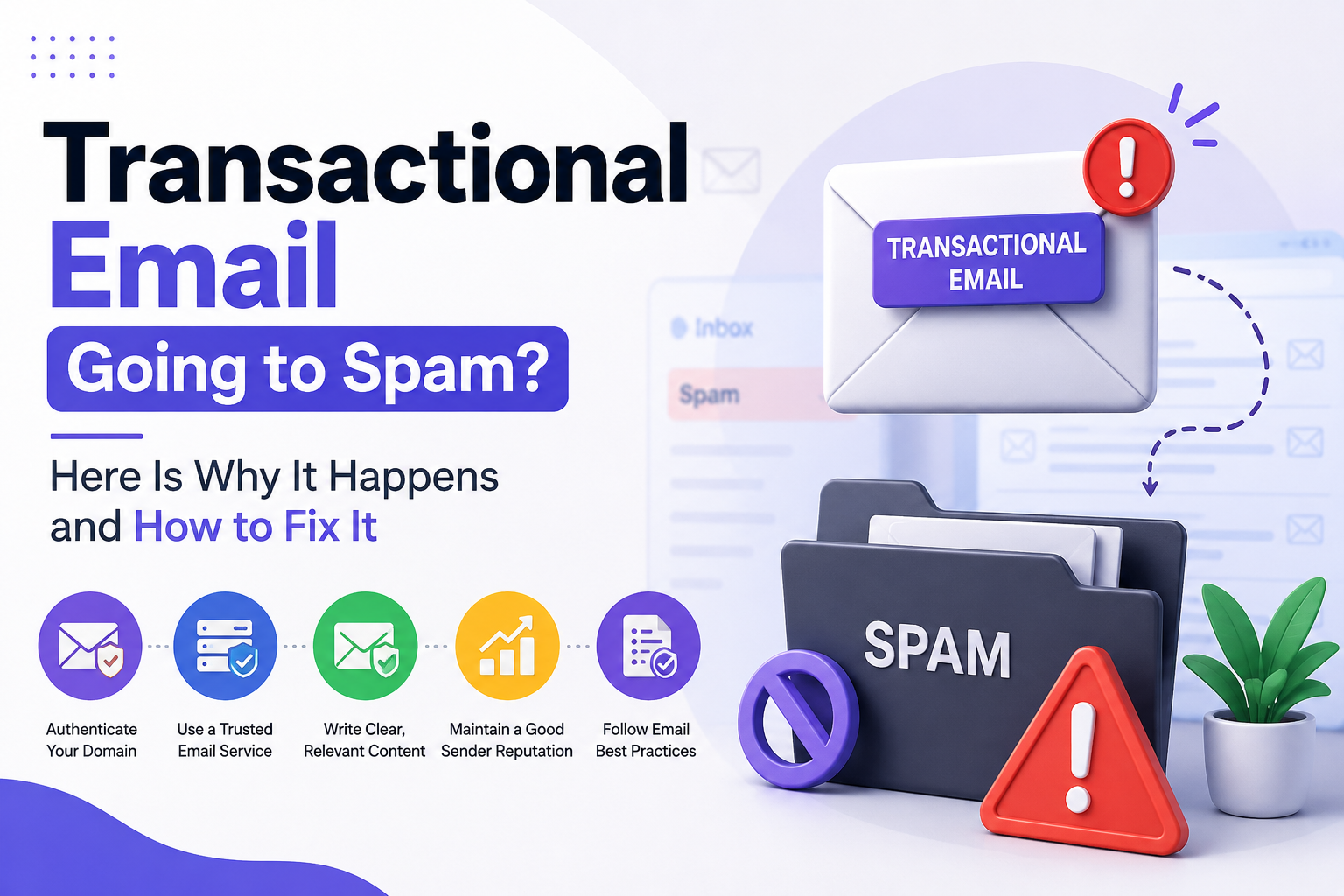
A customer places an order. They check their email for the confirmation. Nothing arrives. They check their spam folder. There it is. And just like that, a completed transaction has been converted into a customer service problem, a potential chargeback dispute, and a damaged first impression of your brand — all because of a deliverability failure that had nothing to do with whether the customer wanted the email.
Transactional email going to spam is one of the most operationally damaging deliverability problems a business can face, precisely because these messages are not optional. Order confirmations, shipping notifications, password reset links, account verification emails — these are emails that recipients are actively waiting for and need to receive. When they land in spam, the consequences are immediate and tangible.
In this guide we explain why transactional emails go to spam and the specific steps that reliably fix the problem.
There is a widespread and dangerous misconception that transactional emails — because they are triggered by a user action rather than a marketing decision — automatically bypass spam filters and reach the inbox. This is categorically false. Spam filters do not know or care that your email is an order confirmation. They evaluate it using the same signals they use for every other email: your sending domain's reputation, your authentication setup, your IP's sending history, and increasingly, the content quality of the message itself.
Transactional emails are actually more vulnerable than marketing emails in one important way: they are typically sent in low volumes from systems that have not been carefully managed for deliverability. A marketing team usually has someone paying attention to delivery rates and open rates. The transactional email system is often managed by a developer who set it up once and considers it handled.
Using a shared IP address for transactional sending without understanding who else is on that IP is one of the most common causes of transactional email deliverability failures. If you are using a shared sending IP through a transactional email provider — SendGrid, Mailgun, Postmark, Amazon SES — and other senders on that IP are generating spam complaints or hitting blacklists, their reputation problems become your deliverability problems. Moving to a dedicated IP is the cleanest solution.
Missing or broken DKIM authentication for your transactional sending domain is the second most common cause. Many businesses have DKIM set up for their marketing email platform but forgot to configure it for the separate domain or subdomain they use for transactional sends. Without DKIM, receiving servers have no cryptographic proof that your transactional emails are genuine. Our email authentication setup guide explains the configuration for common transactional email providers.
Sending transactional email from the same domain and IP as your marketing campaigns is a significant risk for businesses that also send promotional email. If your marketing campaigns generate elevated complaint rates, the resulting reputation damage can affect your transactional sends as well. The correct architecture separates transactional and marketing email onto different subdomains and ideally different IPs.
Transactional emails can fail spam filter content checks in ways that are genuinely surprising. A password reset email that includes an aggressive upsell banner in the footer. An order confirmation that has so many promotional images it looks more like a marketing email than a receipt. A shipping notification packed with discount codes and referral links. All of these blur the line between transactional and promotional in ways that spam filters now catch.
Keep your transactional emails clean, functional, and minimal. They should look and feel like utility emails, not marketing campaigns. The information the recipient needs — order details, tracking number, reset link — should be the entire focus of the message. Any cross-selling or upselling should be subtle and secondary. Our guide on email content best practices covers the content signals that affect deliverability across all email types.
The first step is to check whether the problem is consistent or provider-specific. Ask a few colleagues or friends with Gmail accounts, Outlook accounts, and Yahoo accounts to place test orders or trigger test emails, then report back where the confirmation landed. If your transactional emails are reliably reaching Gmail but going to spam in Outlook, that tells you something very specific about your reputation with Microsoft. Provider-specific problems point to provider-specific solutions.
Check your sending IP against major blacklists using MXToolbox. Verify your SPF, DKIM, and DMARC configuration for your transactional sending domain specifically — not just your marketing domain. Check your transactional email provider's dashboard for any delivery failures, deferrals, or complaint notifications. A full email deliverability audit covers all of these checks systematically and identifies the root cause.
The most reliable long-term solution for transactional email deliverability is to give it its own dedicated infrastructure. A dedicated subdomain (notifications.yourcompany.com or receipts.yourcompany.com), a dedicated IP address, and authentication records specific to that subdomain create a clean, isolated sending identity for your transactional emails. Because transactional emails typically generate very high engagement — recipients open order confirmations at extremely high rates — a dedicated transactional sending stream will naturally build a strong, positive reputation over time.
Our email infrastructure services include designing and implementing exactly this kind of separated infrastructure. We handle the subdomain configuration, authentication setup, IP provisioning, and warm-up so your transactional emails have the best possible foundation for reliable inbox placement.
Order confirmations, shipping updates, and password resets are the emails your customers need most. If these are going to spam, you are creating customer service problems and trust issues that cost far more than the deliverability fix would have.
If your transactional emails are not reliably reaching the inbox, talk to a Formula Inbox expert about diagnosing and fixing the specific cause. Or start with a complimentary inbox placement test to see exactly where your transactional sends are landing across all major providers.
Learn exactly how to set up SPF, DKIM, and DMARC records step by step. Stop emails landing in spam and protect your domain from spoofing in 2026.

Microsoft's 2025–2026 changes to Exchange Online — TERRL, MERRL, and AI-assisted filtering — are breaking cold email infrastructure that worked two years ago.

Master SDR email deliverability. Learn how to avoid spam filters, optimize sending cadence, and boost reply rates with this expert sales outreach guide.
Our highly experienced email deliverability managers consistently help clients achieve inbox placement rates (IPR) of more than 90% by uncovering and resolving the issues that keep messages from their intended recipients. Are you ready to do the same?